How it works
From a payment to access, emails and reporting, with money decided on the server and one gate before every release.
Checkout
Stripe checkout, plus a one-click upsell charged to the saved card.
Signed payment notice
Access comes only from Stripe's signed webhook, never from a browser redirect.
Checks before access
Status, currency, every line item, total, customer and time must all match the offer. If in doubt, grant nothing and alert a person.
A person decides
Access and delivery
Each payment event is recorded once, and a catch-up job replays any that were missed.
Lifecycle email
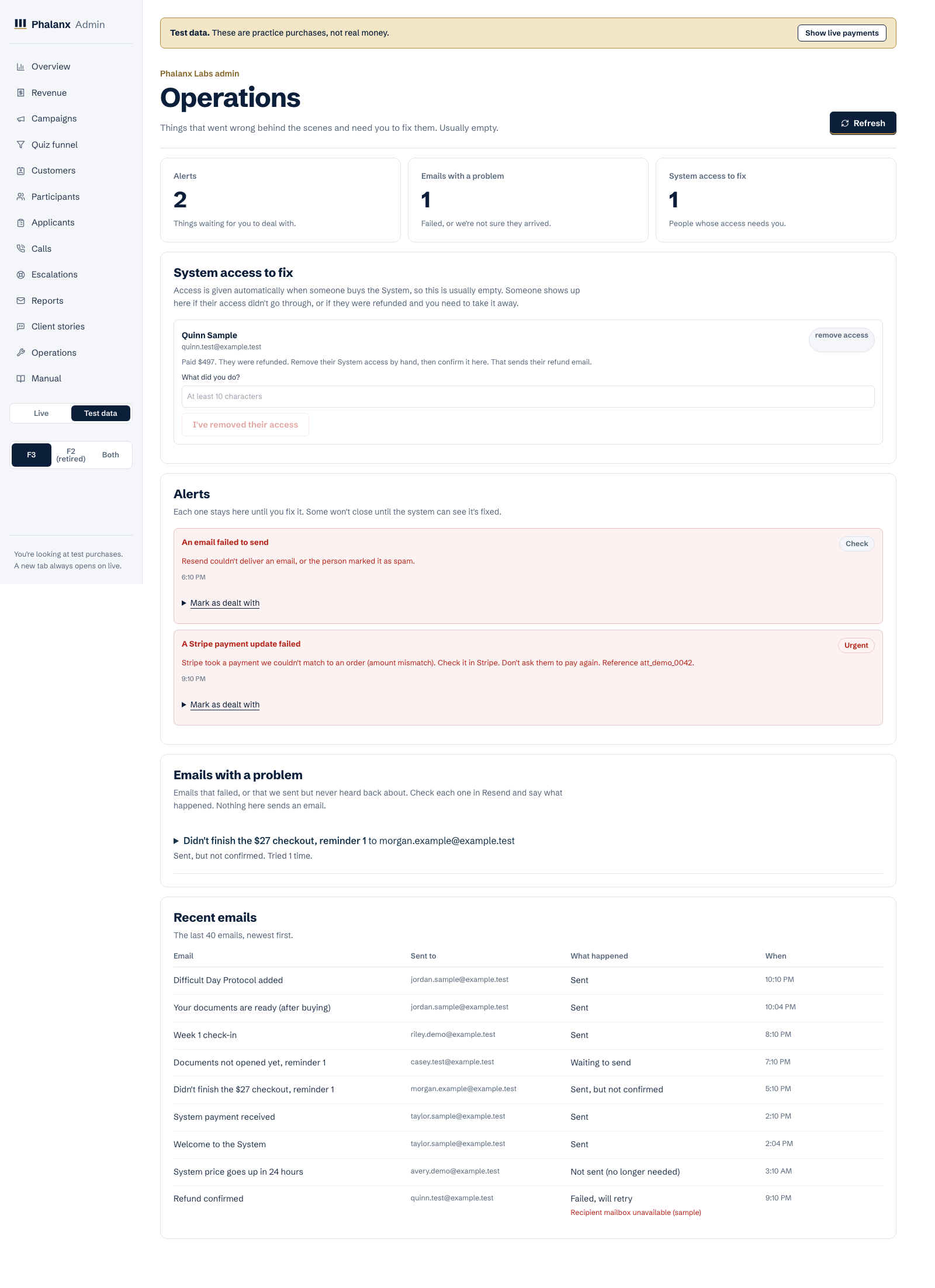
One policy for every send: bounces, complaints and unsubscribes stop everything, and nobody is offered the next product before opening the one they bought.
One ledger
Every report reads one definition of money; unknown traffic is never counted as organic.
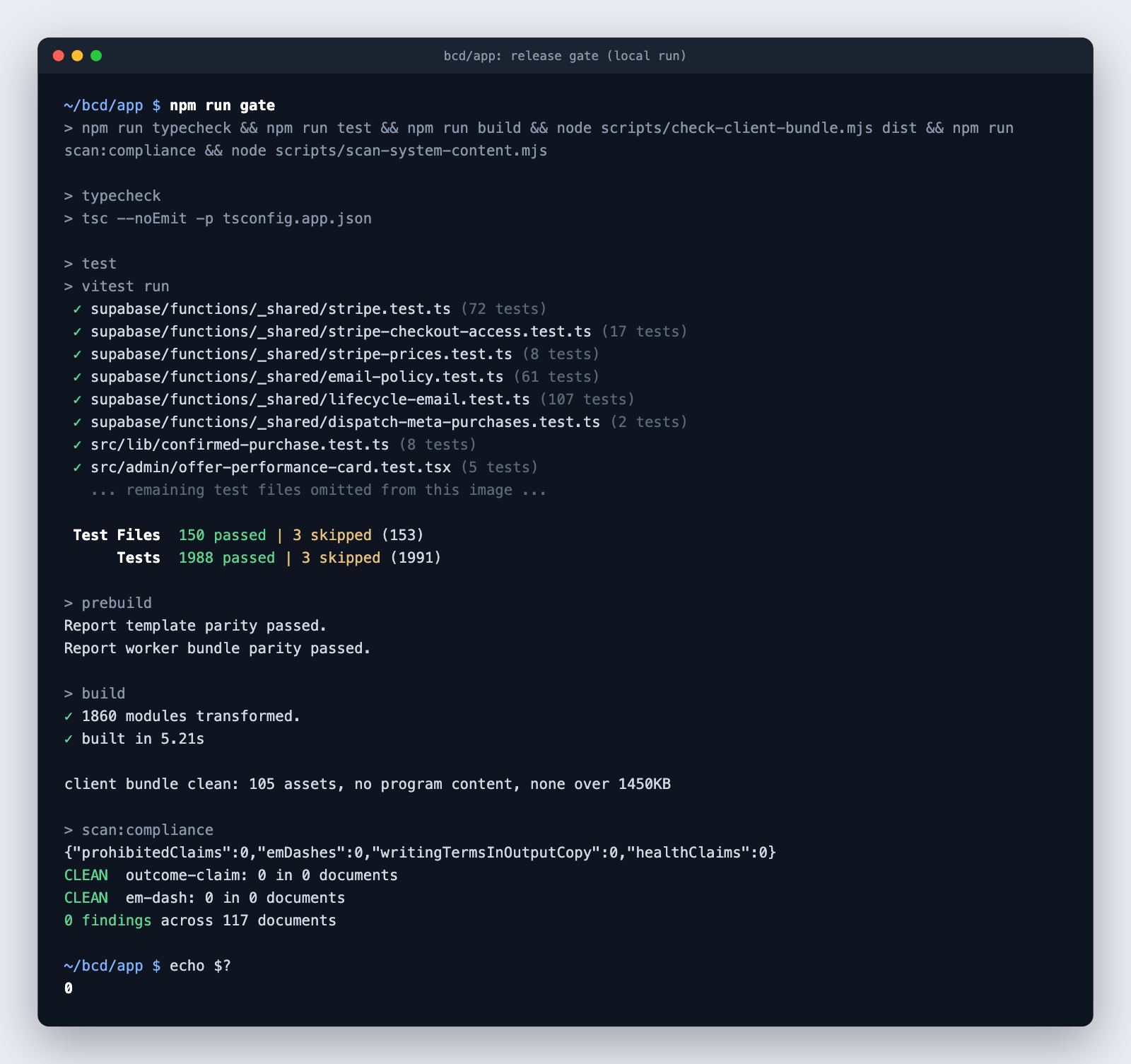
One release gate
About 1,900 tests and 66 database suites must pass before anything ships.
A person decides
The outcome
A sale is taken, checked, fulfilled and followed up with no manual step. Every release passes one gate of about 1,900 automated tests and 66 database test suites. A pre-launch review found six defects, and each was fixed the same day with a regression test (a test that stops the same bug coming back).
The problem
The company sells through a short offer ladder: an entry product, order bumps, a one-click upsell, a core offer at a time-limited price and a premium tier. Each step has its own price rules, deadlines and access, and each buyer's emails depend on what they bought and when. By hand, that's slow and error-prone. Built carelessly, it gives away access or charges the wrong amount.
What I decided
- Money is decided on the server. A browser redirect after payment proves nothing. Access comes only from Stripe's signed payment notification (a webhook), checked against what was offered.
- When in doubt, grant nothing and alert a person.
- One definition of money: a single ledger that every report reads from.
- The ad platform gets the conversion and nothing private.
- Every release passes one gate.
How it was built
The agents drafted the build plans and the code against these rules. I tested and signed off each release.
- Payments: Stripe checkout, plus a one-click upsell charged to the saved card. Each payment event is recorded once, and a catch-up job replays any that were missed.
- Checks before access: the payment's status, currency, every line item, total, customer and time must all match the offer. A refunded or disputed purchase can never flip back to paid.
- Lifecycle email (Resend): one policy covers every send. Bounces, complaints and unsubscribes stop everything, sends are spaced out, and nobody is offered the next product before they've opened the one they bought.
- Ad conversion tracking from the server, with personal fields wiped once sent.
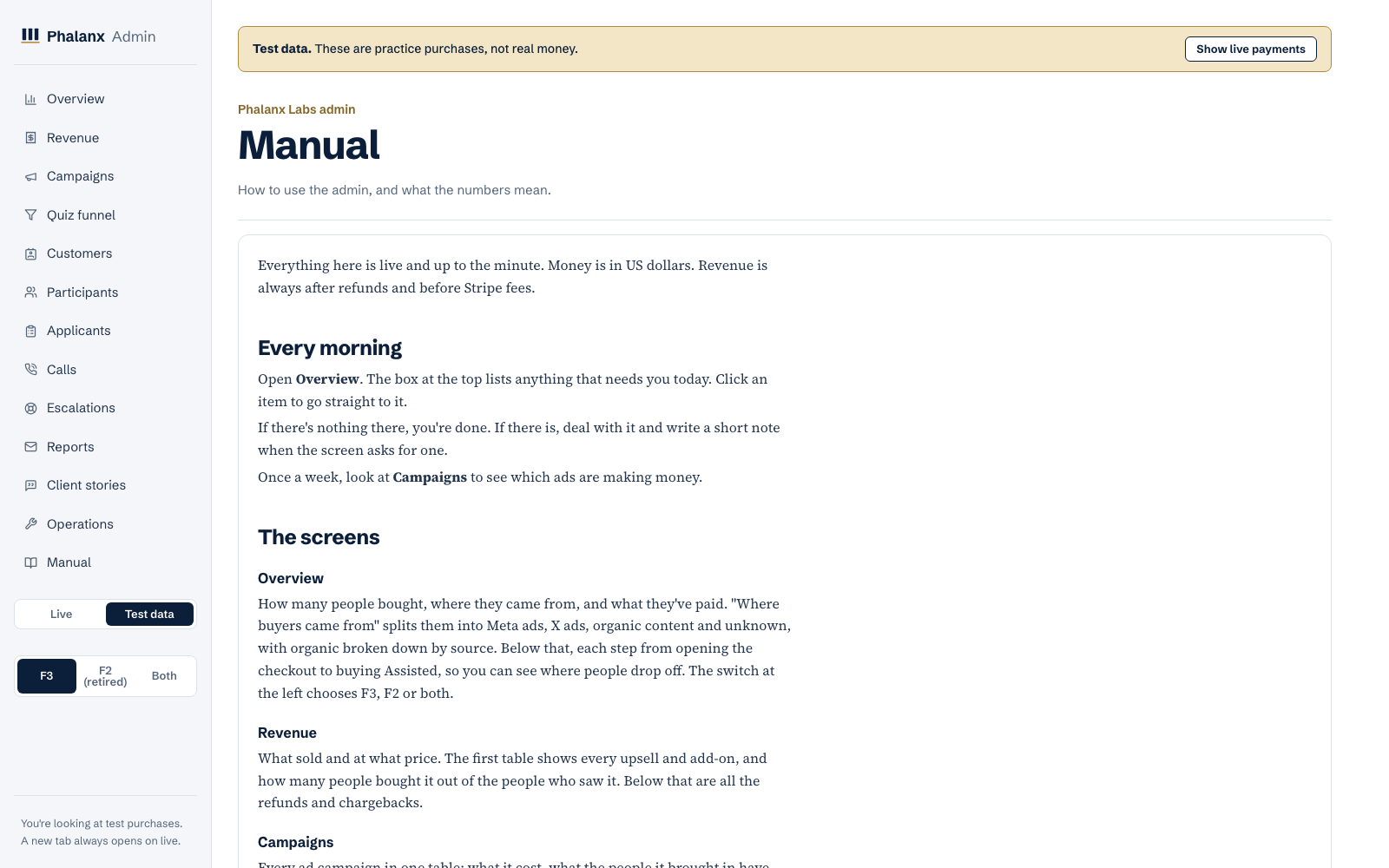
- An admin area with revenue, campaign, customer and operations screens, and a built-in manual explaining how every number is calculated. Traffic is split into paid, organic and unknown, and unknown is never counted as organic.
Results
- One release command runs the type check, about 1,900 automated tests, 66 database test suites, the build, a check that private content hasn't leaked into the public code, and a scan for banned claims.
- The tests catch money bugs. When the money logic was broken on purpose, 4 of 4 database changes and 1 of 1 code change were caught.
- A simulated participant was followed for 106 days against a real local database.
- A late or mismatched payment grants nothing, and a failed or stuck payment event alerts me within a minute. That alert exists because a payment event once failed silently and went unrecorded.
- A separate AI review session audited the build before launch and found six defects, including private links leaking to the analytics tool, quality checks that let failures through, and a weekly report job that marked failures as done.
What I'd do next
Move the email schedule into one tested scheduler, and add step-by-step funnel reporting from the first click.
Screens from the build